![[personal profile]](https://www.dreamwidth.org/img/silk/identity/user.png) penpusher
penpusherYou probably did not know that on October 2nd, 1959, a total eclipse of the sun took place and was seen in its totality over parts of New England, including Boston. Well, it would have been, if it weren't raining at sunrise, in Beantown, when it was happening.
The second day of the tenth month in 1959 was also the date of the premiere of Rod Serling's television series, "The Twilight Zone," and it's perfect that this most spectacular celestial event took place on that particular day and, in a way, perfect that it was obscured. Those are major themes during the run of this series, designed to both disguise and reveal the elements of humanity, just past the midpoint of the 20th Century.
The opening narration is worth noting. Over the title animation, Mr. Serling sets the tone for the series:
"There is a fifth dimension... Beyond that which is known to man. It is a dimension as vast as space and as timeless as infinity. It is the middle ground between light and shadow, between science and superstition. And it lies between the pit of man's fears and the summit of his knowledge. This is the dimension of imagination. It's an area which we call... The Twilight Zone."
That really hits, maybe even harder than it did more than sixty years ago. Because those really are the two ends of that spectrum, fear on one end and knowledge on the other. And that is what we are going through, during this global pandemic. It is both a chilling thought and a life-affirming reminder.
***SPOILERS ABOUT THIS EPISODE MAY BE REVEALED***
This first episode begins with a man (Earl Holliman, best remembered as partner to Angie Dickinson's titular television "Police Woman" in the 1970s) wearing a jump suit with no markings, wandering down a lonely dirt road. The unseen Mr. Serling implores:
"The place is here. The time is now. And the journey into the shadows we are about to watch could be our journey." HA! No doubt, as this story shows a guy encountering a town where no one exists, save one being, which I'll get to in a moment. The timing feels eerily real for the moment I'm writing this, as many places in the country actually are deserted for Social Distancing.
Jump Suit Man doesn't remember who he is, and is puzzled by the fact that a diner he reaches is wide open, a jukebox playing music and a coffeepot on the stove, but no sign of anyone around. He knocks over a clock in the kitchen, breaking the crystal and stopping the timepiece at six-fifteen.
Still later, he finds his way to the main part of town, which any "Back To The Future" fan would instantly recognize as the town square of Hill Valley - the backlot at Universal Pictures commonly referred to as "Courthouse Square." the town seems to be normal in every way, except with no people.
The man spots a woman sitting in the passenger seat of a delivery truck and calls out to her, and it is at this point we see that living being I mentioned. Our guy opens the passenger door and the figure he spoke with falls out, head striking the curb. It's a mannequin. Then, we see a common housefly land and crawl along the edge of the vehicle's door!
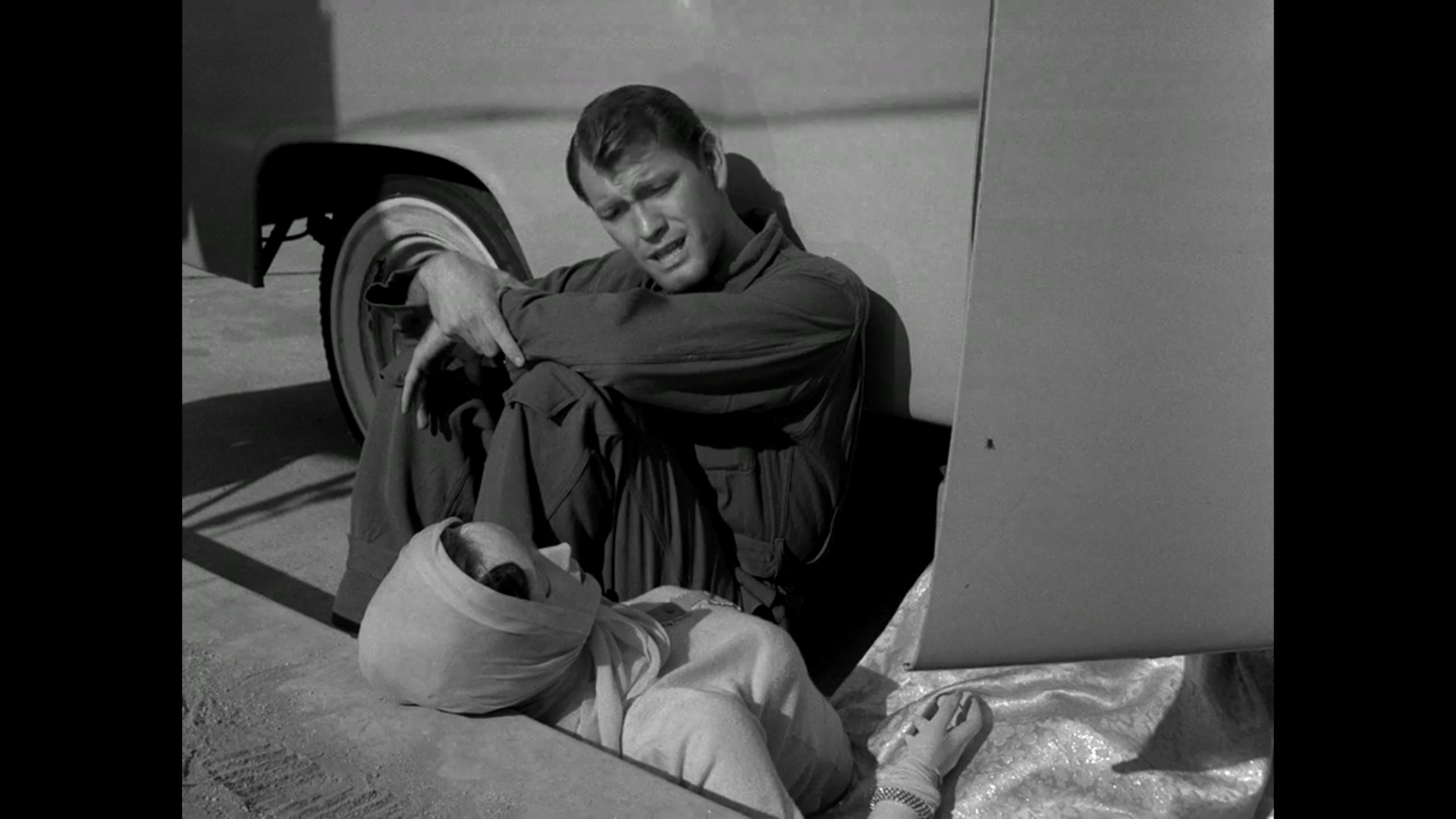
The Unknown, The Unalive and the Unwanted: Holliman, Mannequin and Housefly.
Our anonymous man doesn't see the bug, but we, as the audience, can't miss it. Why, in a town that supposedly has no discernible life, is there a fly hanging around? And why wouldn't the fly be in the café and not on a car door in the sun? The fly is highly visible in the frame, crawling on the outside of the door. It doesn't make sense for it to be there within the premise of the story we're given. And being so prominent it feels even more important, even though the guy apparently never saw it.
After a rush to a telephone ringing in a phone booth in the square and some difficulty getting out of the booth (pull it open, don't push!) and a swing through the police station, where our gent finds a lit cigar in an ash tray, then nearly locks himself in a jail cell (confinement themes are starting to come to the fore), and references of being surveilled ("I wish I could shake that crazy feeling of being watched.") he runs outside to the center of the square and shouts the title of the episode directly into camera. "Where is everybody?"
The second half of the tale lets Holliman spiral down, a very watchable performance, especially considering he had no other actors to play off of, just him and various props and a couple of important mirrors.
The movie house on the square, as in "BTTF," was playing an actual film. For Marty McFly, it was "Cattle Queen of Montana," the Barbara Stanwyck/Ronald Reagan popcorn flick. Here, it was "Battle Hymn," a Rock Hudson War picture based on the true life accounts of Lt. Col. Dean Hess, a fighter pilot in World War II who became a clergyman to atone for accidentally bombing an orphanage, then asked to return to duty during the Korean conflict. The film's poster (not the actual art, just a generic looking man directing an airplane out of a hangar, dressed identically to our anonymous man) jogs his memory enough to help him realize he's in the Air Force.
But when the theater darkens and film of a bomber plane appears on the screen, it's a mad rush to the projection booth to find, of course, no one.
As our guy stumbles and tumbles through, getting so freaked that even the painted eye on the window of an optometrist's office freaks him out, The man frantically pushes the pedestrian crosswalk button attached to the traffic light and we get our very first "Twilight Zone Twist."
As he screams for help, a darkened room with a dozen military officers watch and listen, silently.
"Get him outta there," comes the order and we see the exterior: a small metallic cube where our guy was wired up to monitoring devices and broke the clock over his display at just past six fifteen. He was pressing a signaling button after being in that container for four hundred eighty-four hours, which was, in fact, the expected length of a flight to the Moon, some orbits around it, and the return home.
It was all an endurance test to see if Sergeant Ferris (that's his name and rank) could deal with being trapped in a tin can all the way to our lunar neighbor and back, as it was explained to the press corps that were standing by for the results.
Could this episode have been any influence on why NASA chose to have a three man team for their eventual Apollo missions?
The final conclusion, stated to Sarge by the military doctor as he was being stretchered out is, again, as timely as our current reality:
"We can fill the stomach with concentrates. We can supply microfilm for reading, recreation, even movies of a sort. We can pump oxygen in and waste material, out. But there's one thing we can't simulate that's a very basic need: Man's hunger for companionship. The Barrier of Loneliness. That's one thing we haven't licked yet."
Our need to be around other humans is what this current health crisis is about. We need an "Isolation Generation" to get us through.
Overall, this episode had the standard formula of the series already in place. Elements of intrigue and mystery, a supernatural circumstance, and that surprise reversal that changes what you thought you were watching into a totally different situation.
Holliman, as I stated, was quite watchable, a mix of brash and homespun, he holds your attention right through as he puzzles his way through the emptiness he endures.
I give "Where Is Everybody" a solid 8 out of 10.
The second day of the tenth month in 1959 was also the date of the premiere of Rod Serling's television series, "The Twilight Zone," and it's perfect that this most spectacular celestial event took place on that particular day and, in a way, perfect that it was obscured. Those are major themes during the run of this series, designed to both disguise and reveal the elements of humanity, just past the midpoint of the 20th Century.
The opening narration is worth noting. Over the title animation, Mr. Serling sets the tone for the series:
"There is a fifth dimension... Beyond that which is known to man. It is a dimension as vast as space and as timeless as infinity. It is the middle ground between light and shadow, between science and superstition. And it lies between the pit of man's fears and the summit of his knowledge. This is the dimension of imagination. It's an area which we call... The Twilight Zone."
That really hits, maybe even harder than it did more than sixty years ago. Because those really are the two ends of that spectrum, fear on one end and knowledge on the other. And that is what we are going through, during this global pandemic. It is both a chilling thought and a life-affirming reminder.
***SPOILERS ABOUT THIS EPISODE MAY BE REVEALED***
This first episode begins with a man (Earl Holliman, best remembered as partner to Angie Dickinson's titular television "Police Woman" in the 1970s) wearing a jump suit with no markings, wandering down a lonely dirt road. The unseen Mr. Serling implores:
"The place is here. The time is now. And the journey into the shadows we are about to watch could be our journey." HA! No doubt, as this story shows a guy encountering a town where no one exists, save one being, which I'll get to in a moment. The timing feels eerily real for the moment I'm writing this, as many places in the country actually are deserted for Social Distancing.
Jump Suit Man doesn't remember who he is, and is puzzled by the fact that a diner he reaches is wide open, a jukebox playing music and a coffeepot on the stove, but no sign of anyone around. He knocks over a clock in the kitchen, breaking the crystal and stopping the timepiece at six-fifteen.
Still later, he finds his way to the main part of town, which any "Back To The Future" fan would instantly recognize as the town square of Hill Valley - the backlot at Universal Pictures commonly referred to as "Courthouse Square." the town seems to be normal in every way, except with no people.
The man spots a woman sitting in the passenger seat of a delivery truck and calls out to her, and it is at this point we see that living being I mentioned. Our guy opens the passenger door and the figure he spoke with falls out, head striking the curb. It's a mannequin. Then, we see a common housefly land and crawl along the edge of the vehicle's door!
The Unknown, The Unalive and the Unwanted: Holliman, Mannequin and Housefly.
Our anonymous man doesn't see the bug, but we, as the audience, can't miss it. Why, in a town that supposedly has no discernible life, is there a fly hanging around? And why wouldn't the fly be in the café and not on a car door in the sun? The fly is highly visible in the frame, crawling on the outside of the door. It doesn't make sense for it to be there within the premise of the story we're given. And being so prominent it feels even more important, even though the guy apparently never saw it.
After a rush to a telephone ringing in a phone booth in the square and some difficulty getting out of the booth (pull it open, don't push!) and a swing through the police station, where our gent finds a lit cigar in an ash tray, then nearly locks himself in a jail cell (confinement themes are starting to come to the fore), and references of being surveilled ("I wish I could shake that crazy feeling of being watched.") he runs outside to the center of the square and shouts the title of the episode directly into camera. "Where is everybody?"
The second half of the tale lets Holliman spiral down, a very watchable performance, especially considering he had no other actors to play off of, just him and various props and a couple of important mirrors.
The movie house on the square, as in "BTTF," was playing an actual film. For Marty McFly, it was "Cattle Queen of Montana," the Barbara Stanwyck/Ronald Reagan popcorn flick. Here, it was "Battle Hymn," a Rock Hudson War picture based on the true life accounts of Lt. Col. Dean Hess, a fighter pilot in World War II who became a clergyman to atone for accidentally bombing an orphanage, then asked to return to duty during the Korean conflict. The film's poster (not the actual art, just a generic looking man directing an airplane out of a hangar, dressed identically to our anonymous man) jogs his memory enough to help him realize he's in the Air Force.
But when the theater darkens and film of a bomber plane appears on the screen, it's a mad rush to the projection booth to find, of course, no one.
As our guy stumbles and tumbles through, getting so freaked that even the painted eye on the window of an optometrist's office freaks him out, The man frantically pushes the pedestrian crosswalk button attached to the traffic light and we get our very first "Twilight Zone Twist."
As he screams for help, a darkened room with a dozen military officers watch and listen, silently.
"Get him outta there," comes the order and we see the exterior: a small metallic cube where our guy was wired up to monitoring devices and broke the clock over his display at just past six fifteen. He was pressing a signaling button after being in that container for four hundred eighty-four hours, which was, in fact, the expected length of a flight to the Moon, some orbits around it, and the return home.
It was all an endurance test to see if Sergeant Ferris (that's his name and rank) could deal with being trapped in a tin can all the way to our lunar neighbor and back, as it was explained to the press corps that were standing by for the results.
Could this episode have been any influence on why NASA chose to have a three man team for their eventual Apollo missions?
The final conclusion, stated to Sarge by the military doctor as he was being stretchered out is, again, as timely as our current reality:
"We can fill the stomach with concentrates. We can supply microfilm for reading, recreation, even movies of a sort. We can pump oxygen in and waste material, out. But there's one thing we can't simulate that's a very basic need: Man's hunger for companionship. The Barrier of Loneliness. That's one thing we haven't licked yet."
Our need to be around other humans is what this current health crisis is about. We need an "Isolation Generation" to get us through.
Overall, this episode had the standard formula of the series already in place. Elements of intrigue and mystery, a supernatural circumstance, and that surprise reversal that changes what you thought you were watching into a totally different situation.
Holliman, as I stated, was quite watchable, a mix of brash and homespun, he holds your attention right through as he puzzles his way through the emptiness he endures.
I give "Where Is Everybody" a solid 8 out of 10.